The Pollsters were not wrong!
The media regularly drive me nuts. The ability to think through a problem regularly seems to be Zero. Everyone is flabbergasted by the UK election – “I will never trust a poll again” said one distraught losing politician. How could this have happened? I remember looking at Nate Silvers 538 protections – the polling guru and shaking my head, trying to call the bookies and wanting to place a bet. I had a very clear idea of what was going to happen (I was torn 50/50 as to whether Cameron would get an outright majority) – but I knew he would get close. So what is every one missing?
- The polls were correct – they had to be. But therein lay Labour’s and the Liberal’s downfall.
First the dynamics of the British election cannot be compared to the USA. The key statisticians like Nate Silver, Sam Wang – knew almost precisely what the 2012 USA election result was going to be, but their views did not impact the environment that they were monitoring. On a micro scale a poll can drive the narrative – thus impacting the final results.
Now let’s go back to the UK and take us back to the week end before the election. Virtually every poll said the same thing. Neck and neck – both main parties’ at 33%. Because of Britain’s first past the post system, even a party with 15-20% support can end up with virtually no seats. Such a forecast would actually be good for Labour – because Labour has a slight inbuilt advantage in the UK electoral system i.e. at 33% a piece labour would very likely end with more seats than the Conservatives. (The specific dynamics of Scotland on this occasion would distort that statement)
The British Electoral system allows the party in power to determine the election date, subject to a maximum period of five years. The Tories (Conservatives) thus have five years to make everything look nice and tidy. There is no question that the British economy outperformed the rest of Europe –ironically via austerity which is usually a bad idea in a deflationary environment—but that is a different story.
The fact is the economy had been salvaged and the future looks OK. As a general rule, if you can take credit for an improving economy you tend to get reelected. But the Tories were not feeling the love. They had done disastrously in the 2014 European parliamentary elections. The winning British party was UKIP, a party that from nowhere got 27.5% of the popular vote– a party that at the time did not have a single MP. And herein lies the vital clue to the “mysterious” 2015 General Election.
UKIP is a party to the right of the Conservatives. They want the UK to pull out of Europe. Their major beef was immigration policy. Both Labor and Conservative parties had a consistent track record of making promises to cap immigration and then failing to meet such caps by massive margins. The electorate was furious—a pent up fury built on for over a decade of empty promises.
The other factor was the Scottish National Party (SNP) – the pollsters correctly predicting that they would obliterate all opposition in Scotland. Now w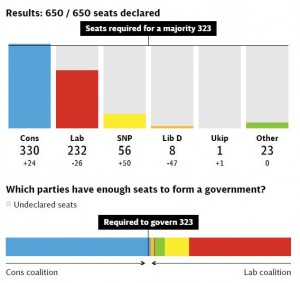 hat this means is that the SNP –who are to the left of Labour, would naturally ally themselves with the Labour party– a coalition that is not so interested in immigration issues, but might be forced to consider another Scottish referendum – and no body (except the inhabitants of Glasgow maybe) wants to go through that again. Labour desperately tried to assure voters that they would not form coalition with the SNP. Really? Of course they would say that and of course such an assurance was totally meaningless. Scotland, Labour and the SNP are all pretty much the same thing to an English voter.
Because the polls were so consistent, they were obviously accurate—therefore the electorate had a very clear impression of what was going to unfold – a probable Labour /SNP minority Government with one rather useless UKIP MP. Thus there would be less chance of reform on Europe/immigration, more chance of the Scots being a pest (they didn’t build Hadrian’s wall without good reason) and an economic agenda that was not particularly credible. So if you are a UKIP voter what do you do? If you are a Liberal voter seeing that your party is toast -what do you do. The British electorate (or the English at least) using the polls as their road map – the British people got as close as possible to what they actually wanted.

Actually the UK economy performed dismally under the Tories, and the reason is better than the rest of Europe is that they pursued less austerity. See this http://nakedkeynesianism.blogspot.com/2015/05/comparative-austerity-does-cameron-re.html and this http://mainlymacro.blogspot.com/2015/05/blaming-keynes.html
Informative, yet oddly, in spite of spending considerable time thinking about it, I feel none the wiser. Perhaps the chart needs to play out, plus go back a few more years – but it seems to me on the one hand the that USA had the most dramatic increase in 2009 leading to a faster rebound, yet it looks to me like the UK had more austerity than Germany. But then my gut was that the UK had more fat to trim than the USA. I strongly believed in the USA reflationary policies – but was more circumspect as to what the UK had done.